

Posts with tag "corset"

In Defense of Ready-to-Wear Corsets

Victoria Dagger in a RTW “Vamp” corset by Pop Antique. Photo by Karolina Marek.

Let me start this post with two disclaimers:
1) I love corsets.
2) A good fit is absolutely key in a corset.

But I don’t think that fully custom is the only way to achieve a good fit in a corset.

Victoria Dagger in a Pop Antique “Flirt” RTW corset, which has a fit comparable to the Valentine shown below.  Victoria is 5’3″.  Photo by Andres Razo.

(Bonus disclaimer: I’m not talking about the kind of ready-to-wear corset that is sweatshop mass-produced with no shape and/or flimsy plastic bones, etc.  As far as I’m concerned, those aren’t even really corsets.)

I touched upon this a bit in a previous post, What (You Didn’t Know) to Look for in a Corset, but I’d like to go into it in more detail.  Unusual for an independent, handmade corsetiere, I actually love to specialize in a ready-to-wear fit rather than bespoke.  My line is called Pop Antique, and to me, there’s a really exciting challenge in creating a single corset pattern that fits an assortment of bodies.  It really pushes me to think about the body, what works, what doesn’t, what has the most wiggle room, etc.

Ulorin Vex in a Pop Antique RTW “Valentine” corset, paired with latex leggings and bolero.  Ulorin is 5’9″ tall.

Now, don’t get me wrong: this is not an article about how custom corsets are redundant and a waste of money, by any stretch.  The going theory is that because RTW corsets try to fit everyone, they actually fit no one, because the percentage of people with truly standard proportions are so small.

Victoria Dagger in a Dollymop for Dark Garden RTW bridal corset. Photo by Chris Gaede.

And maybe that last part is true.  Maybe no one is the ancient Greek ideal of proportion in every single limb.  But most corsets fit only from mid-hip to just above or below the bust, so it doesn’t matter as much if you have short legs or a long pelvis or long arms or broad shoulders or a short neck or a big forehead or any number of other minor differences in proportion.  And in my experience, even if you do have a proportion difference in your torso that affects corset fit, it is often something that can be addressed with one or two simple pattern changes, if it’s not corrected by a slight variation in the lacing gap.  Most commonly, the top or bottom edge will need to be raised or lowered to accommodate torso length, or there will be a circumference change to the rib or hip.

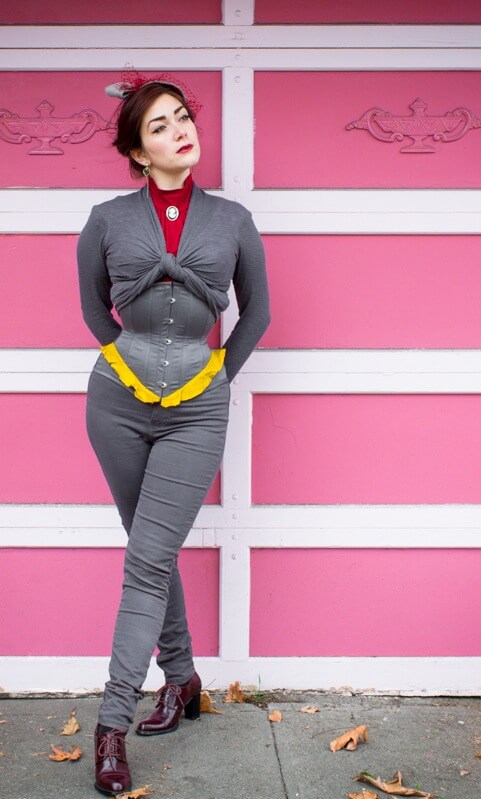
Model and client Elisa Berlin wears her 17″ Ingenue corset by Pop Antique – this shape was achieved with only two pattern changes from the ready-to-wear shape. Photo by Jon Bean Hastings.

The fact of the matter is, ready-to-wear, when designed well, is designed to fit as much of that corsetiere’s target market as possible.  Key to that train of thought are the words “target market” and “designed well.”  Just as each corsetiere has their own aesthetic in terms of color, embellishment, and fabrication, each corsetiere has a different silhouette ideal in their mind, is particularly sensitive to certain fit or comfort issues, and has a different demographic forming their local client base.  If a ready-to-wear fit isn’t right for you, it may just be that the corsetiere’s ready-to-wear line is designed for a different body type or standing posture.  It doesn’t mean their patterns are bad or that your body is shaped weirdly.  And if you are tied to working with that particular corsetmaker (we appreciate your interest and loyalty!), then that’s a great time to talk about pattern adjustments or bespoke fit.

Victoria Dagger in a custom Dark Garden “Grable” corset. Though Dark Garden typically uses flat steels throughout, this fashion show piece was made with spiral steels in deference to Victoria’s preference: having worn many ready-to-wear corsets, it didn’t take long to find out that flat steels bruise her rib cage. © Mask Photo.

You may be wondering if the bespoke corset wouldn’t be a better choice anyway – why not just go for full custom for the first time, and every time?  I want to play devil’s advocate with you for a minute (although RTW corsets are far from the devil).  By wearing corsets, we learn about corsets and our own body and how the two interact.  You learn things from wearing a fully-constructed corset for hours or days that you wouldn’t know from having your measurements taken or a mockup fitting.  You learn that your ribs are really squishy – or really not.  You learn if the compressible part of your waist is very short or long.  You learn about the shape of a back curve that puts pressure on your spine, or your favorite hip spring silhouette.  The more experienced corsetieres will know what to look for and how to balance a lot of those things out, but ultimately we are not psychic, especially if you are ordering online and doing a remote fitting and we can’t even touch you.  And that’s why I think wearing ready-to-wear corsets before you launch into the investment of a fully custom corset is not only valid, but valuable.

Model Raven Le Faye in a Pop Antique RTW size “Demoiselle” sweater corset. Photo by Andres Razo.

Ultimately, ready to wear and custom corsets both come in different grades of quality.  No matter which route you choose, do your research.  A handmade RTW corset is very different from one produced in a Chinese sweatshop, of course, but consider this scenario: some bespoke corsetieres may have a RTW line that they rarely sell and therefore haven’t fully developed or prototyped in an adequate range of styles and sizes.  When designing my ready-to-wear line, I did extensive market research into sizing, then used three fit models of the same size with very different body types to test my samples.  I’m still making tweaks here and there (and that ability is one of the great things about being a small designer and doing everything in-house).  Dark Garden built its ready-to-wear line based its exhaustive archive of custom corset patterns.  And a custom corset from a corsetiere with 5 or 10 or 20 years of experience is very different from one made by someone who is just launching their corset business after making a few corsets for his or herself and a few friends.  When you are corset shopping, that is not the time to bargain hunt.

Model Whitney McCabe backstage at a Pop Antique fashion show, in a RTW Vixen. Whitney, who has only occasionally corseted in the past, wore this ribbon corset all evening – it was so comfortable that she didn’t take it off until after our round of post-show drinks, when she had to leave her ensemble with me.

Do you own any ready-to-wear corsets, or only bespoke?  Who makes your favorite ready-to-wear fit?

The Longline Bra is Reborn: 8 Favorite Picks!

I was at a dinner party recently when a svelte professor friend of mine pulled me aside conspiratorially.  It was Oscar season and everyone had been gossiping about their picks.  What could this woman want to confide in me, I wondered?  But as a lingerie designer I’m pretty used to being sought out for quiet talks about skivvies and other generally private matters.

She leaned in and said, “I am obsessed with longline bras.”  I asked why, and she said they fit her small rib cage and bust in a way that lent support while not causing any digging or discomfort.  She also thought the appearance was more flattering, since there was more fabric in the silhouette and this had an effect of making the area appear larger.  I asked to see (for professional reasons!) and she dartingly looked around at the room full of wine-soaked women and gay men and then lifted her shirt to show me her adorable longline bra from independent brand Fortnight.

The longline bra trend has been going on for a few seasons, and it’s nice to see a reinterpretation of an old silhouette that has been neglected for many years.

Longline bras are those that extend a few inches below the bottom of the cup, over the ribcage and sometimes as far as just above the navel.  Sometimes they are structured like bustiers and have shaping properties.

The longline bra had its heyday in the midcentury, when dresses fit tightly over the rib cage and waist.  A longline bra did the all-in-one job of supporting and shaping the bust as well as slimming the rib cage.  A girdle or structured slip might take over shaping from the rib cage through the waist and hips.  Longline bras were especially good foundations under the popular strapless dresses of the 1950′s since their length allowed them to fit the body more securely without requiring straps in order to stay in place.  They were the functional foundation for the bombshell silhouette of the era–though they were not necessarily considered especially sexy or fashionable pieces as standalone lingerie. 

During the more minimalist lingerie eras of the 60′s and 70′s they all but disappeared in favor of soft cup triangle “no-bra bras,” and haven’t reemerged as fashion pieces until recently.   The longline is a cousin of the bustier, which has maintained a presence since the 80′s, but it can differ in a few ways.  Bustiers are sometimes designed to be worn as ready to wear, and feature strong boning and wiring in their waist and cup structure.  They are often associated with statement-making surface prints, designs, and fabrics that may refer to modes like traditional corsetry, punk, vintage costume, body-con, or hyper embellishment. 

What’s emerged recently in the longline bra is a much softer and sweeter approach.  The length does not necessarily serve a shaping purpose, and in some cases doesn’t involve boning at all.  Here are some favorites of mine:

RETRO AND STRUCTURED

The two styles below make reference to the more structured origin of the retro longline bra.  Va bien is known as a shapewear brand, and I like how this style is both functional as well as sexy (Floral strech lace and power tulle, along with ultra-lift cups and a low plunge).

Va Bien Marquise Plunge Basque $85

Bordelle is a great fashion brand that does gorgeous things with powerful stretch materials and references to feminine bondagewear.  This bra is modern and sexy while having a structured feel to it.

Bordelle Lady Citron Bodice Bra $380

PRETTY AND GIRLY

This new generation of longline bras focus on floral and ditsy prints, lightweight fabrics with low stretch content, and are not designed for shapewear function.

Fortnight Vega Longline $120

Stella McCartney Laura Pottering Bustier Bra, $110.00

By Eloise Dotted Lines Bra $38

La Lilouche Lily Pearl Bralette $118

SOFT BRA

A different direction for the longline trend is the sweet unstructured stretch bralette, designed for light support and a general air of sweetness.

b.Tempt’d by Wacoal Bralette, $18

Only Hearts Lou Lou longline bra $86

What are your thoughts on longline bras?  I’ve read that some larger sized women prefer them because they allow breast weight to be distributed around the rib cage, and I’ve heard others claim they’re hard to find and sizing is difficult.  Any favorite styles or brands?

Laura a.k.a. Lola Haze

I’ve loved lingerie since before that was reasonable. I taught myself drawing, designing, and sewing, and after graduating from Harvard with an English degree, immediately went to work disregarding it and following my passion for fashion. After a few years designing for a big company, I went off on my own and started Lola Haze TM, (named after the title character in “Lolita,” my favorite book). Lola Haze is playwear for the bold woman who loves fun and dresses for herself! I feel happy and lucky that I get to love my job so much, and am thrilled to share my lingerie enthusiasm with The Lingerie Addict!

More Posts - Website

Follow Me:
TwitterFacebook

How to Care for a Corset, Part 3: Corset Storage

Corsets: betcha can’t have just one – but how do you store them all?
Model: Victoria Dagger; Photo: Joel Aron; Corset: Dark Garden

With the winter holiday season officially over, many of us are sorting through the accumulated rubble of our various gifts received and parties thrown.  As for me, I also have been in the process of unpacking from my first move in four years, so as well as picking up a season’s worth of cocktail dresses from my dressing room floor, I have to sort and put away all my regular clothes, including my collection of corsets.  There are several different ways to store a corset; today I’ll cover four basic ways, plus a bonus decorative storage method that I’ve always secretly wanted to try.

Hmmm… wherever shall I put all these corsets??
Model: Victoria Dagger; Photo: Sam Guss; Corset: Sparklewren

1. Laced and laid flat in a drawer
This is perhaps the most simple and obvious solution.  Between wearings, tighten the laces on your corset until its gap is fully closed.  (Put one of the busk loops behind the stud side of the busk while fastening the others like normal; the tension will keep the busk from opening itself.)  Tie off the excess lacing into a bow and then pull it straight up, tucking it inside the corset at the center back.  Lay your corset flat in a drawer, stacking your collection but being careful not to place anything adjacent to a delicate fabric (such as a lace overlay) that might snag it (including the busk of another corset).  You may also fold your corsets in thirds if your drawer is the wrong proportion for them to lay flat.  Depending on the shape distribution and boning pattern, some corsets may not fold well.  Alternatively, you can place them semi-upright in a bin instead of flat in a drawer.

Placing one of the busk loops inside the corset will keep the busk fastened for storage.

Corsets laced shut, folded, and stored semi-upright in a bin at Dark Garden Unique Corsetry.

2. Rolled up and stored in a drawer or bin
With your corset unlaced, roll your corset up around itself, starting with the stud side of the busk and leaving the fashion fabric facing outwards.  When you get to the lacing gap, keep rolling but make sure you catch the ribbon loops at that point.  As with the previous method, the boning placement may affect how well your corset rolls, but the rolling shouldn’t cause any damage to the bones, even for long-term storage.
If you are concerned about your fabric getting dirty or abraded (white corsets, lace overlays, rhinestone detailing, etc.), you may wish to protect it by then wrapping it in a corset bag, pillow case, or perhaps even the leg cut from a pair of nylons.  I wouldn’t recommend storing all of your corsets wrapped if you have a lot of them, as it’ll be hard to tell them all apart if you can’t see the fabric clearly.

3. Hanging from its laces on a hanger
This is how most of my corsets are stored.  You can have your corsets laced or unlaced for this method, but I like to leave them unlaced because then it’s easier to get back into them.  Simply flop your corset over the bar on a hanger so it’s suspended by its laces.  Use a sturdy hanger as the weight of the corset can cause bowing or drooping.  I like to use tiered slack hangers, as closet space is at a high premium for me.  The boning pattern makes no difference with this method; however, protecting more fragile fabrics is less straightforward.  Though I’ve yet to try it, you could place a piece of fabric over the corset in question, like a dropcloth, perhaps pinning a couple of places to keep it from sliding right off every time you go for the adjacent corset or article of clothing.

I like to store my corsets hanging from their laces on a tiered slacks hanger.

4. Laced closed and hanging facing out
Using the busk trick from the first storage method, lace your corset fully shut and tie off the waist loops.  You can tuck the bow into the top of the corset as above, or wrap it around the neck of your hanger.
Method A:  As well as the hanger, you’ll also need some ribbon (probably about two feet should be sufficient) and two safety pins, such as the tiny gold ones that come with a lot of clothing and lingerie.  Cut your ribbon in half (burn the ends if you don’t want it to fray), then fold it in half.  Pin through both layers of ribbon (on the cut end) to the lining of your corset at the side seam to create your own hanger loops.  If your corset is too wide to hang well this way, try pinning the ribbon ends separately to front and back, like a spaghetti strap closer to the princess line.
Method B: Use a skirt hanger, protecting your fabric from the grips with padding made from scraps of fabric or wider ribbon, such as a soft cotton twill.  (Try not to use the padding pieces each time you unclip your corset!)  This method works best for corsets that are roughly the same height all the way across; less well for sweetheart and low-back styles, particularly in larger sizes.
This will create a nice boutique-like feel, particularly if you use high quality, matching hangers.

Corsets clipped to skirt hangers, with padding protecting their fabric from the clips. Dark Garden Unique Corsetry.

When storing your corsets flat (in a drawer or bin, or on a hanger), tighten the laces fully, tie off your “bunny ears,” and tuck them into the top of the corset as shown to keep them tidy and out of the way.

5. Displayed proudly on your wall
I’ve always thought a beautiful and clever way to both store and display a few corsets would be to hang them on my way, like pieces of art.  Follow the directions to hang a corset laced shut, and choose an attractive hanger (such as these padded hangers) from which to hang it.  Then, find a frame that is large enough for the corset and the hanger both.  You won’t need the matboard or the glass – check vintage and thrift stores for bargains on frames missing these components.  Tap in a nail or coat hook where you’d like the top of the hanger to be, hold up the frame for placement, then add a second nail above for the frame.
One warning: leaving your corsets hanging for too long could of course result in them getting dirty or discolored, so be careful about where they’re placed, check them regularly to see if they need cleaning, and perhaps rotate the display every so often.  This is not a long-term storage solution.

You can find some great frames without glass at thrift stores – perfect for displaying a three-dimensional piece like a corset!

How do you store your corsets?  Do you have a method not listed above?  Please share in the comments.

Lingerie school: the corset and basque project

Design by Karolina Laskowska: backstage at the catwalk show

As usual, the end of term at lingerie school (ak.a. the Contour Fashion course at De Montfort University) saw every student in a state of panic – deadlines were starting to loom from all angles and stress was mounting!  Our final assignment was the corset & basque project – a rather self-explanatory project that required us to design, pattern cut and sew a corset and basque, with an extra bit of pressure – our class also had to organise and present a fashion show with our final designs! As unfortunate as it was that you all missed the catwalk, I thought I’d make up for it as best as I could by sharing some of my classmates’ and my own designs and explaining our inspirations behind them. Enjoy!

Karolina Laskowska

On the catwalk, photo by Andy Espin

Sketchbook work

Experimental photography

Idea sketches

Textile development – appliqué and flossing

Illustrations of final designs

Using the colour black is my comfort zone when it comes to design, so I really wanted to push myself and embrace colours in this project. I began by looking at flowers; orchids with their tropical hues, the process of decay in cut flowers and finally the surreal colours within Jiang Zhi’s photographic series ‘Love Letters’, where beautiful flower arrangements are doused in methylated spirits and set alight, surrounding them in an intensely beautiful blue flame.  I was also greatly influenced by my Summer internship with Sparklewren corsetry – I’m still in awe of Jenni’s beautiful use of lace appliqué and had been dying to use the technique on some of my own work. My final designs ended up far more colourful than I could have ever anticipated – and I’m very pleased to say I’m incredibly happy with the final garments and how they looked on the catwalk!

Charlotte Spence

Final corset on the catwalk

Sketchbook and textile development

Sketchbook development

Sketchbook development

Final design illustrations

Corset details

Charlotte Spence’s designs were originally inspired by Summer Lupins, pastel shades and the blending of colours.  The main fabric for her corset was a hand dyed brocade that incorporated hand dyed pleats. She wanted to use ribboning as an embellishment, which led to her studying hand carved candles and opening the pleats into organic shapes to create interesting lines on her corset.  The corset’s shape originated from a 1885 sports corset pattern, with the eyelets supposedly ‘aerating’ the body.

Emily Roberts

Final corset on the catwalk

Final basque on the catwalk

Initial inspiration

Sketchbook development

Sketchbook development

Emily was inspired by a trip to Barcelona and its amazing architecture, particularly Gaudi’s work and traditional Spanish buildings.  She focused on metalwork and recreated the aesthetic by using lace with embellishment.

Samantha Thorburn

Final garment on the catwalk

Sketchbook development

Design development

Design development

Final garment details

Samantha’s designs were inspired by the characters Odette and Odile from Swan Lake, after seeing the Birmingham Royal Ballet perform the ballet. She also went to see the collection of historical ballet costumes at the Royal Opera house and was particularly taken with the embroidered details on the costumes, as well as the stories and personalities of the characters.  Her catwalk basque represented the character of Odette.

Akaibi Vine

Final garments backstage

Catwalk back views

Sketchbook development

Textile development

Design development

Final designs

Final garment details

Akaibi’s initial inspiration came from a visit to photographer Tim Walker’s ‘Storyteller’ exhibition and the the Disney inspired Christmas window displays at British department store Harrods. She wanted to create a modern twist on fairytales – not just the characters and stories but the backdrops, costumes and atmosphere created when modern artists turn their hand to these classic tales. She explored the idea of using a whitework (a type of embroidery), being more inspired by textures and finishes than colours or prints. For her final garments she laminated various fabrics and worked onto them with beading and ribbon work. The longline basque and corset worn with a skirt are both nods to the gowns of the Disney princesses with a modern finish.

As manic and crazy as the catwalk day, we just about managed to all survive! We all managed to pull together to create a fantastic show that somehow made all of the tears and stress worth it. I’m incredibly proud of what our class managed to achieve and it’s set a very high standard for the rest of the year’s work!

Readers: What do you think of our final designs? Have you ever had your own catwalk experiences?

Karolina

Karolina

Student at De Montfort University's world-renowned Contour Fashion course. Makes many knickers in her spare time.

More Posts - Website

So You Want to Be a Lingerie Designer: 3 Amazing Online Community Resources

A flossed corset by Pop Antique, as shot by Karolina Marek on Victoria Dagger. Much of my corsetmaking knowledge comes from researching via various online communities.

This being November, many Americans such as myself are pondering those things which we have to be grateful.  Trite though it may be, I knew I wanted to touch upon it in my column this month.  One thing I am continually grateful for on a daily basis is being a 21st century woman, regardless of my nostalgic admiration for things antiquated and retro.  I love that we have the freedom to enjoy and embrace these old fashioned aesthetics without being obligated to adhere to (sexist) ideals of the day, and that we can pick and choose when and where we want to employ these aesthetics, mixing and matching old and new with utter abandon according to our personal taste and daily whims.  I love modern medicine and technology, which brings me to the crux of the matter (you knew there was a point in there somewhere!): I love the internet and its infinite capacity for connection and knowledge both.  With that in mind, here are three amazing online communities for various skill levels.  As I am, primarily, a corsetmaker, there is naturally a bit of an emphasis on that field.

Corset interior with floating modesty panel by Electra Designs, founder of the Learn to Make Corsets Like a Pro group on Facebook.

Learn to Make Corsets Like a Pro
A Facebook group founded by Alexis Black (of Electra Designs), which she created to go with her successful Kickstarter for corsetmaking resources.  The community is open to members of all skill levels and backgrounds, and a typical post will be either a specific question regarding construction and troubleshooting of corset construction, or merely an enthusiastic update on the status of a current project.  Alexis herself will regularly chip in to answer questions, and overall the group is very responsive and helpful, allowing one to get a reading on several opinions and possible solutions.

Foundations Revealed is an amazing subscription-based resource for anyone interested in learning to make foundation garments, particularly corsets.

Foundations Revealed
When you’re ready to kick it up a notch, Cathy Hay’s Foundations Revealed has you covered.  While there’s a heavy emphasis on corsetry, they also have articles on making girdles, bras, and even bum rolls!  Foundations Revealed is a subscription-based site, and as they add a new article every week I find it well worth the money for the variety of the articles and authors.  There are articles appropriate to every skill level, from basics to complicated experimental designs.  As well as a wealth of information on various patterning and construction techniques, they also have articles on the topic of running a business.  If you’re not sure about committing to $12 per month, sight unseen, check out their selection of free articles.  Foundations Revealed also recently launched its own forum.

The Lingerie Addict herself, Cora Harrington, founded a safe and private Facebook group for Independent Lingerie Professionals.

Independent Lingerie Professionals
Founded by The Lingerie Addict herself, Cora Harrington, Independent Lingerie Professionals is a small, private community for independent lingerie professionals, from designers and retailers to boudoir photographers, media outlets, and beyond.  If not invited directly, you must be vetted by group moderators for admission, and you must stay actively engaged to remain in the group.  Within the community, we talk about a range of topics: When presented with a new or particularly challenging situation, we have an amazing community to ask for advice, but we also share articles about lingerie/the industry, social media utilization, etc.  Even those posts that aren’t directly relevant to me, I find interesting as they give insight to other facets of the industry.

Are you an indie designer?  Do you participate in any of these communities?  What other online resources do you find valuable?  Tell us in the comments!